


The 23rd edition of the FIFA World Cup begins in Mexico City on Thursday, and those viewers who recall the 1970 tournament may well marvel at just how much has changed over the years; here, broadcasting historian Philip Barker looks back at how Mexico’s first two stints as hosts were presented on TV, and also when the USA welcomed the world in 1994…

These days, the World Cup is just about the only time when everyone watches the same thing at the same time.
It always used to be before the explosion of satellite TV and streaming platforms.
Although all the pre-tournament noise might make you think otherwise, there are three host nations – a first time for Canada, a second for the USA, and the third for Mexico, the host nation on their own in 1970 and 1986.
The Opening Ceremony in Mexico’s giant Azteca Stadium is expected to feature Burna Boy and Shakira performing the official song “Dai Dai” which, it must be said, bears more than a passing resemblance to Shakira’s 2010 offering “Waka Waka This Time for Africa.”
The opening match follows, Mexico against South Africa, just as it was in 2010.
Rewind to 1970, Mexico’s first time as hosts. Many matches kicked off under midday sun, which was early evening time in Europe. As the late Brian Glanville wrote, a tournament “prostituted to European Television.”
There was a parade of schoolboys wearing the strips of the 16 teams. Mexican sailors carried the flags. Then (gasp!) a release of balloons. After all that, Mexico drew 0-0 with the Soviet Union in a soporific encounter notable only for the first use of the yellow card.
It wasn’t an omen. Brazil swept Czechoslovakia aside 4-1, and those famous yellow shirts dominated a tournament still fondly remembered today.
With Jimmy Hill and our first SJA President, John Bromley, at the helm, ITV had a panel of experts kept in order by presenter Brian Moore.
They included Manchester City coach Malcolm Allison, who was particularly critical of England midfielder Alan Mullery. Word filtered back, and the following season, Mullery confronted Allison in ITV’s “Big Match” studio. It was compelling viewing.
The BBC’s leading commentator, Kenneth Wolstenholme, also had a grievance. The Radio Times billing for the final failed to mention him, and he discovered programme bosses were plotting to give David Coleman the commentary if England reached the final.
Wolstenholme sought legal advice. “If the BBC wanted to give the commentary to anyone else, I could have had an injunction, which would have been very nasty,” he told The Guardian years later.
England lost 3-2 to Germany in the quarters, so Wolstenholme was in the Azteca rather than the courtroom for the final. “They seem to take it in turns to give an exhibition,” was his verdict on Brazil’s entrancing fourth goal against Italy.
Devious Diego, and a classy comeback from Barry Davies
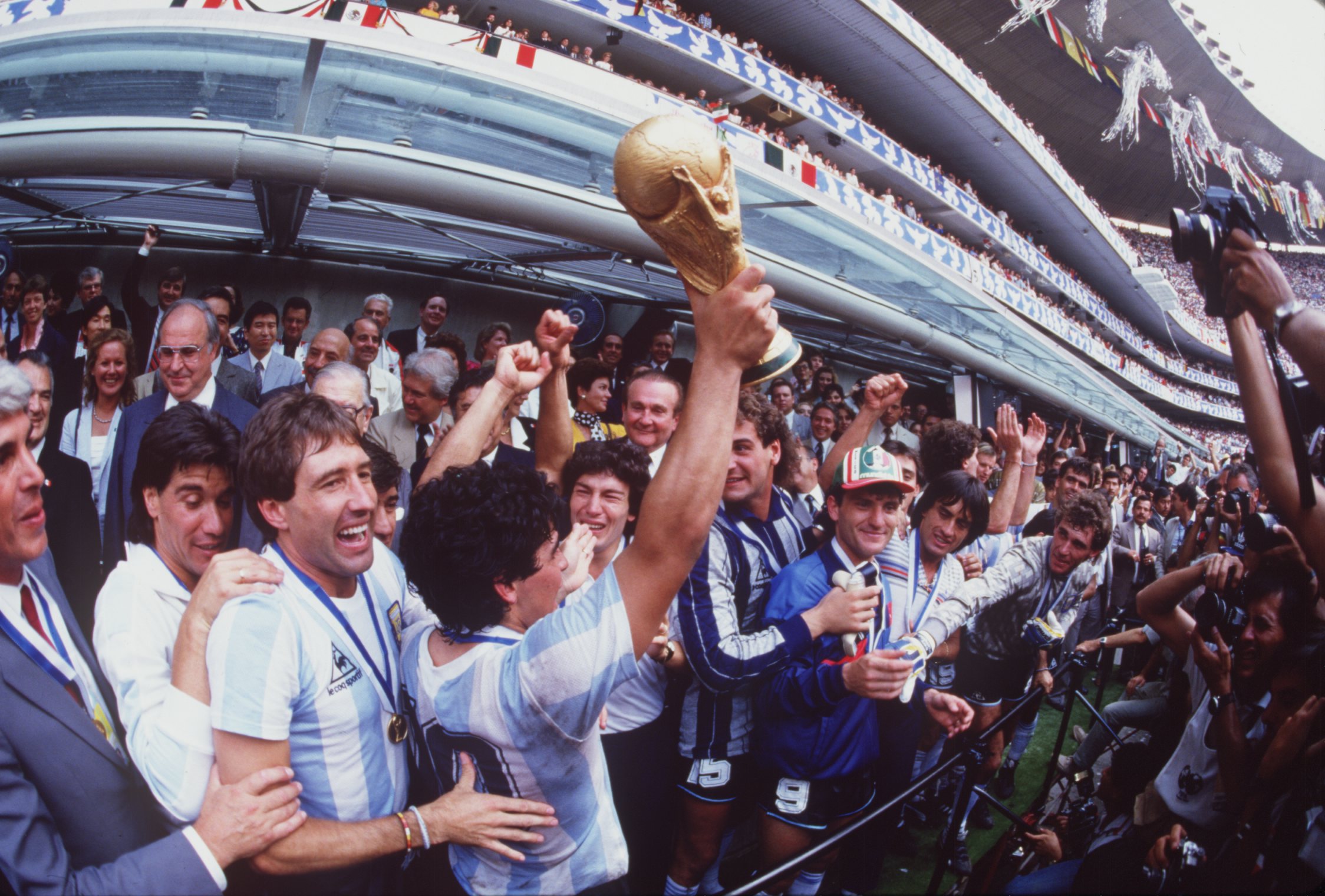
The 1986 tournament was staged at short notice by Mexico after Colombia withdrew, but in September 1985, a terrible earthquake struck, claiming at least 5,000 lives. The Mexicans insisted the tournament would go ahead as planned, but the International Broadcasting Centre was all but destroyed.
Early in the tournament, it became clear that not all the technical facilities were up to scratch. ITV showed Brazil’s match against Spain, but the commentary from Peter Brackley in Mexico disappeared into the ether. Brian Moore was obliged to pick it up from London.
Other countries received no pictures, commentary in the wrong language, or none at all. Canada’s tournament debut against France was also affected.
“We can call it a catastrophe,” said Spanish TV boss Manuel Romero at a European Broadcasting Union media conference where a refund of “the appropriate amount for facilities and services that we have not received” was demanded.
Matters were much improved by the time England met Argentina, or should that simply be Diego Maradona, in the quarter-final. A match which had THAT handball.
Until the replay was shown, many viewers didn’t spot Maradona’s use of what he described as “the Hand of God”. The referee certainly didn’t.
“A bit of a nightmare,” BBC TV commentator Barry Davies recalled later. “I took a chance and suggested maybe he was offside, which was a farcical thing to say because there was no way.”
Very quickly, though, Davies asked: “Was it a use of the hand that England were complaining about?”
Fellow commentator John Motson observed: “If he did feel bad about that, he absolutely excelled himself with his description of the second.”
Maradona did to Belgium in the semis what he’d done to England (at least with the second goal) and masterminded victory in the final over West Germany.
Eight years later, the World Cup landed in America, but although USA ’94 chief Alan Rothenburg insisted the tournament “changed everything”, it speaks volumes that a miskick by Diana Ross at the opening ceremony remains one of the most memorable moments.
TV cameras had been placed at ground level for close-up goal celebrations. Maradona scored against Greece in Argentina’s first match, but his eyes bulged in tell-tale fashion as he raced towards the lens. Something was very wrong. A positive drug test for the world’s greatest player was the sensation of the tournament.
For ITV, Matt Lorenzo followed in the footsteps of Brian Moore as presenter. Although criticised in the press, he didn’t do a lot wrong. The only trouble is that he was up against Desmond Lynam, then in his pomp as the BBC’s star presenter.
Brazil eventually beat Italy on penalties after a goalless 120 minutes, one of the worst finals of all time. “World Cup Grandstand” included highlights of the Three Tenors concert from the night before, ensuring there was at least some entertainment on offer.
Alan Partridge tries to explain the format of the 1994 World Cup finals with the never-to-be-forgotten Soccermeter. pic.twitter.com/xRZlxOrz8q
— Mark O'Haire (@MarkOHaire) June 9, 2026
The SJA is interested in your sports media industry news and views. Keen to reach an engaged audience, including over 70,000 followers across social media? We welcome your enquiries – contact us here. We also offer advertising and sponsorship opportunities.
For information on how to apply as a Full or Associate Member of the SJA, plus details of our free-to-enter SJA Academy, click here.